WhatsApp Business API Pricing in India, Explained (What You’ll Actually Pay)
Quick answer: WhatsApp Business API pricing in India comes down to 2 bills: Meta’s per-message fees, where marketing templates run about ₹0.86 each, and your platform subscription, which on WaMark starts at ₹999/month. Replies inside the 24-hour service window are charged too since 1 October 2026, at about ₹0.115 each. Here’s how both halves add up for a real shop.
WhatsApp Business API pricing in India has two halves: Meta’s per-message charges and the platform subscription you pick. Real INR numbers below, plus a worked example you can map to your own business.
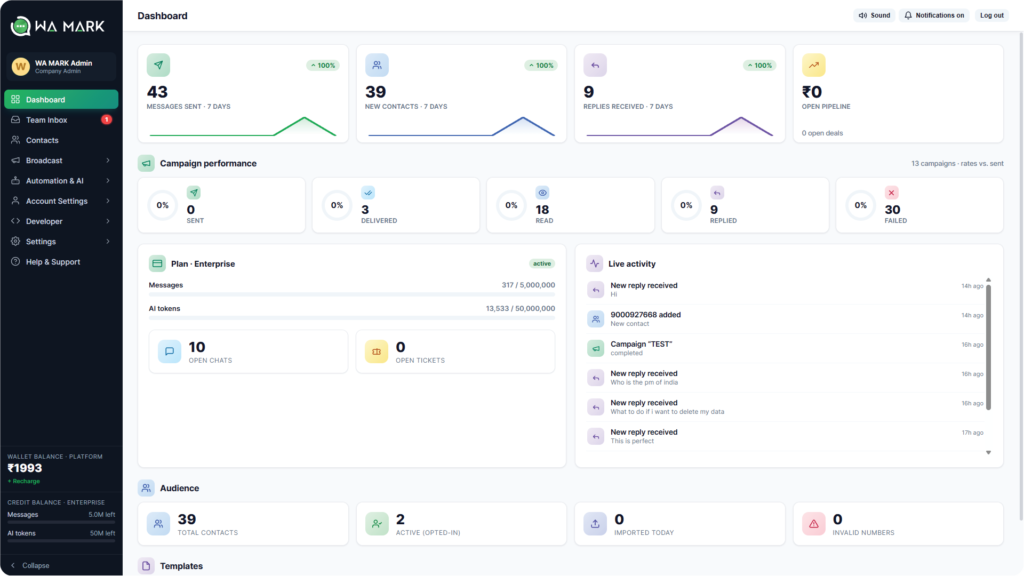
The WaMark dashboard: broadcasts, AI chatbots and a shared team inbox in one place.Ask three providers what the WhatsApp Business API costs and you’ll get three answers that don’t match. Each one is quoting a different half of the bill, and most pricing pages only show you the half that flatters them. India is WhatsApp’s largest market; reports put it above 500 million users.
The two halves of every WhatsApp bill
Half one: Meta’s message fees. Meta charges for template messages you send, the campaign and notification messages that start a conversation. This money goes to Meta no matter which platform you use.Half two: the platform subscription. The API is raw plumbing. It has no inbox, no campaign builder, no chatbots, no team features. Platforms like WaMark provide that layer, and that’s the subscription you compare when you shop around.Any provider quoting one number is folding these together, usually with a markup on the Meta fees buried inside. Always ask: what does Meta get, and what do you get?
Half one: what Meta charges in India
Meta prices messages by category. The figures below are approximate for India; Meta revises its rate card from time to time, so treat them as the right order of magnitude rather than gospel:
Marketing messages (promotions, offers, new-collection announcements): about ₹0.86 each (₹0.8631 on Meta’s India card since 1 January 2026).
Utility messages (order confirmations, delivery updates, payment reminders): around ₹0.115 each, and since 1 October 2026 inside an open customer-service window too.
Authentication messages (OTPs and login codes): ₹0.115 each.
Service replies (a customer messages you and you reply within 24 hours): about ₹0.115 each since 1 October 2026. Some vendors report a free monthly allowance per number, so check WhatsApp Manager for yours.
Replies are still the cheap side of the card: about ₹0.115 to answer a customer against ₹0.86 to start a marketing conversation. Customer messages to you are free, and so is the free window that opens after a Click-to-WhatsApp ad (Meta’s pricing page says it can stay open up to 7 days).
Half two: what the platform charges
This is where comparison shopping happens. WaMark’s plans, as of writing (current prices always on the pricing page):
Plan
Monthly
Built for
Basic
₹999
One person: 1 agent, 1 number, 1,000 contacts
Starter
₹2,999
Small teams: 3 agents, 1 number, 5,000 contacts, team inbox
Growth
₹6,999
Growing teams: 10 agents, 3 numbers, 25,000 contacts, chatbots, AI agent, API and webhooks
Billing is in INR through Razorpay, with automatic GST invoices, and prices are before 18% GST. Pay yearly on Starter, Growth or Business and you save roughly 2 months. Every plan runs on the official Cloud API: same infrastructure, same delivery, whichever tier you’re on.
A worked example: boutique with 3,000 customers
Say you run a clothing boutique with a 3,000-contact opted-in list, and you send 2 campaigns a month: a new-arrivals announcement and a mid-month offer.
Meta fees: 6,000 marketing messages × ~₹0.86 ≈ ₹5,160/month
Platform: the Growth plan at ₹6,999/month, because it includes 6,000 campaign messages a month
Total: about ₹12,160/month before GST, or roughly ₹4 per customer on the list
Compare that with what those 6,000 messages earn. WhatsApp campaigns in retail routinely see 90%+ open rates and double-digit click-throughs, numbers email hasn’t seen since 2005. If 2 campaigns bring even 30 customers through the door at a ₹2,000 average bill, the channel covers its own cost about 5 times over.And the running conversations (size queries, “is this in stock?”, order follow-ups) cost about ₹0.115 a reply since 1 October 2026, while your customers’ own messages are free.
Work out your own bill
Pick a plan, connect a number and see the estimated cost before every send. Plans start at ₹999 a month before 18% GST.
Marketing templates doing utility work. An order confirmation written with promotional flair can get classified as marketing, at 7 times the price. Keep transactional templates plain.
Blasting the full list. The biggest single saving is segmenting properly: 2,000 interested recipients beat 20,000 indifferent ones on cost and on your quality rating.
Missing the 24-hour window. Reply to customers inside the window and it costs about ₹0.115; let it lapse and re-opening the conversation needs a marketing template at about ₹0.86. A staffed inbox still saves money.
Per-message markups. Some providers add 10–30% on top of Meta’s fees and don’t itemise it. WaMark passes Meta’s fees through at cost: Meta bills them to your WhatsApp Business account, and WaMark adds nothing on top.
Common questions
Is there a setup fee or a security deposit?
No setup fee, no deposit. Pick a plan on the pricing page (they start at ₹999/month), connect your number, make sure your WhatsApp account has a payment method for Meta’s message fees, and start.
Do incoming messages cost anything?
No. Receiving is free. Replies within 24 hours of the customer’s last message were free until 30 September 2026; since 1 October 2026 each one is charged at the utility rate, about ₹0.115 in India.
What’s a “conversation” vs a “message”?
Meta has shifted its billing from 24-hour conversation bundles to per-message pricing for templates. In practice: count the template messages you plan to send, multiply by the category rate, and you have your Meta budget.
Can I cap my spend?
A campaign shows its estimated cost before you launch it, and that is the most it can cost, so a typo in audience size shows up before it costs you.A small business doing WhatsApp marketing properly in India spends ₹999 to ₹6,999 a month on the platform, depending on team size, and a campaign-dependent amount on Meta fees, while the support side of the channel costs a fraction of a marketing message. Run your own numbers on the pricing page, or ask us and we’ll budget your first quarter with you.
WhatsApp Business API pricing in India: the bottom line
WhatsApp Business API pricing in India is two lines on a bill: Meta’s per-message charges (marketing templates run about ₹0.86, and replies inside the 24-hour window about ₹0.115 since 1 October 2026) and your platform’s subscription. Pick a provider that bills in INR, itemises Meta’s fees and sends proper GST invoices, and the costs stay predictable.
WhatsApp Business API pricing in India: FAQs
How much does the WhatsApp Business API cost in India?
WhatsApp Business API pricing in India has two parts: Meta’s message charges (marketing templates run about ₹0.86 each, replies inside the 24-hour window about ₹0.115) and your platform’s monthly subscription, which on WaMark starts at ₹999 before GST.
Is WhatsApp Business API pricing in India cheaper for yearly plans?
Yes. WaMark’s yearly Starter, Growth and Business plans cost 10 months instead of 12, so effective WhatsApp Business API pricing in India drops by roughly 2 months’ cost when you pay yearly.
Are there free options?
Customer messages to you are free, and so is the free window after a Click-to-WhatsApp ad (up to 7 days, per Meta’s pricing page). Since 1 October 2026 your replies inside the 24-hour window are charged at the utility rate (about ₹0.115). WaMark itself is paid-only, from ₹999/month, so the cheapest way to test WhatsApp Business API pricing in India is a month on the Basic plan.
We use cookies and similar technologies to collect and process information about your use of this website — to improve the site, tailor our marketing and give you a more personalised experience. Choose “Accept” to consent, or “View preferences” to decide per category.
Functional
Always active
The technical storage or access is strictly necessary for the legitimate purpose of enabling the use of a specific service explicitly requested by the subscriber or user, or for the sole purpose of carrying out the transmission of a communication over an electronic communications network.
Preferences
The technical storage or access is necessary for the legitimate purpose of storing preferences that are not requested by the subscriber or user.
Statistics
The technical storage or access that is used exclusively for statistical purposes.The technical storage or access that is used exclusively for anonymous statistical purposes. Without a subpoena, voluntary compliance on the part of your Internet Service Provider, or additional records from a third party, information stored or retrieved for this purpose alone cannot usually be used to identify you.
Marketing
The technical storage or access is required to create user profiles to send advertising, or to track the user on a website or across several websites for similar marketing purposes.