Here is the number that matters for a small shop. Send 500 offers, 200 order updates and answer 600 customer questions in a month, and your Meta bill is roughly ₹455 before GST. Before October the same month cost about ₹432.
That gap looks tiny. It stops looking tiny when your support team answers 3,000 chats a month, and I’ll show that sum below. First, what actually changed.
Meta’s pricing page says it only changes prices on the first day of a quarter (1 January, 1 April, 1 July or 1 October). The 1 October 2026 update touched two things.
Marketing and authentication prices did not change on 1 October, and India’s list rates didn’t move that day either. The India marketing rate went up on 1 January 2026.
Two other details from Meta’s pricing documentation are easy to miss. Meta’s own Business AI agent is charged by token ($2.00 per million tokens, which Meta puts at roughly 4 to 5 cents per message). And accounts without a payment method on file by 30 September 2026 may find service messages stop delivering once the free 1,000 is used up.
Since 1 July 2025 Meta bills per delivered message, and 24-hour conversation pricing is over. The old “1,000 free conversations” is gone. Prices follow the recipient’s country code, so a message to a +91 number uses the India rate.
| Message type | India rate, before 18% GST | When it applies |
|---|---|---|
| Marketing template | ₹0.8631 | Offers, launches, re-engagement |
| Utility template | ₹0.115 | Order, payment, delivery and appointment updates. Charged inside the window again since 1 Oct 2026 |
| Authentication template | ₹0.115 | OTPs and login codes |
| Service (free-form) reply | Free for the first 1,000 a month per number, then billed (about ₹0.115) | Replies inside the 24-hour window |
| Message the customer sends you | Free | Always |
One honest warning on those figures. Meta’s page links to its India rate cards as downloadable files, and the fetched page text did not print the rupee amounts. Several providers quote ₹0.115 for the utility rate. AiSensy’s October 2026 write-up shows ₹0.145 for the same lines and ₹1.09 for marketing. The gap could be a markup or a different rate card, and I couldn’t confirm which.
So treat ₹0.115 to ₹0.145 as the range for utility, and read the exact number off your own WhatsApp Manager rate card before you budget.
Free exceptions remain. A Click-to-WhatsApp ad opens a free entry window. Meta’s page now says it may stay open up to 7 days, though some provider write-ups still say 72 hours. Everything you send in that window is free. Our Click-to-WhatsApp ads guide covers how to use it.
I used the list rates above (₹0.8631 marketing, ₹0.115 utility and for billed service replies). Swap in your own rate card numbers if they differ.
500 marketing messages, 200 order updates, 600 service replies.
100 marketing messages, 300 appointment reminders, 2,500 service replies.
Look at B. The service replies, which used to cost nothing, are now more than half the bill.
5,000 marketing messages, 3,000 order and shipping updates, 4,000 service replies.
Marketing is still 86% of the Meta bill here (4,315.50 of 5,005.50). The October change added about ₹690 to this store’s month (the utility-in-window and service lines), if all 3,000 updates were sent inside open windows.
These bills cover Meta only. Your software subscription comes on top. For what that looks like, see our WhatsApp Business API pricing guide.
See your own message costs per campaign
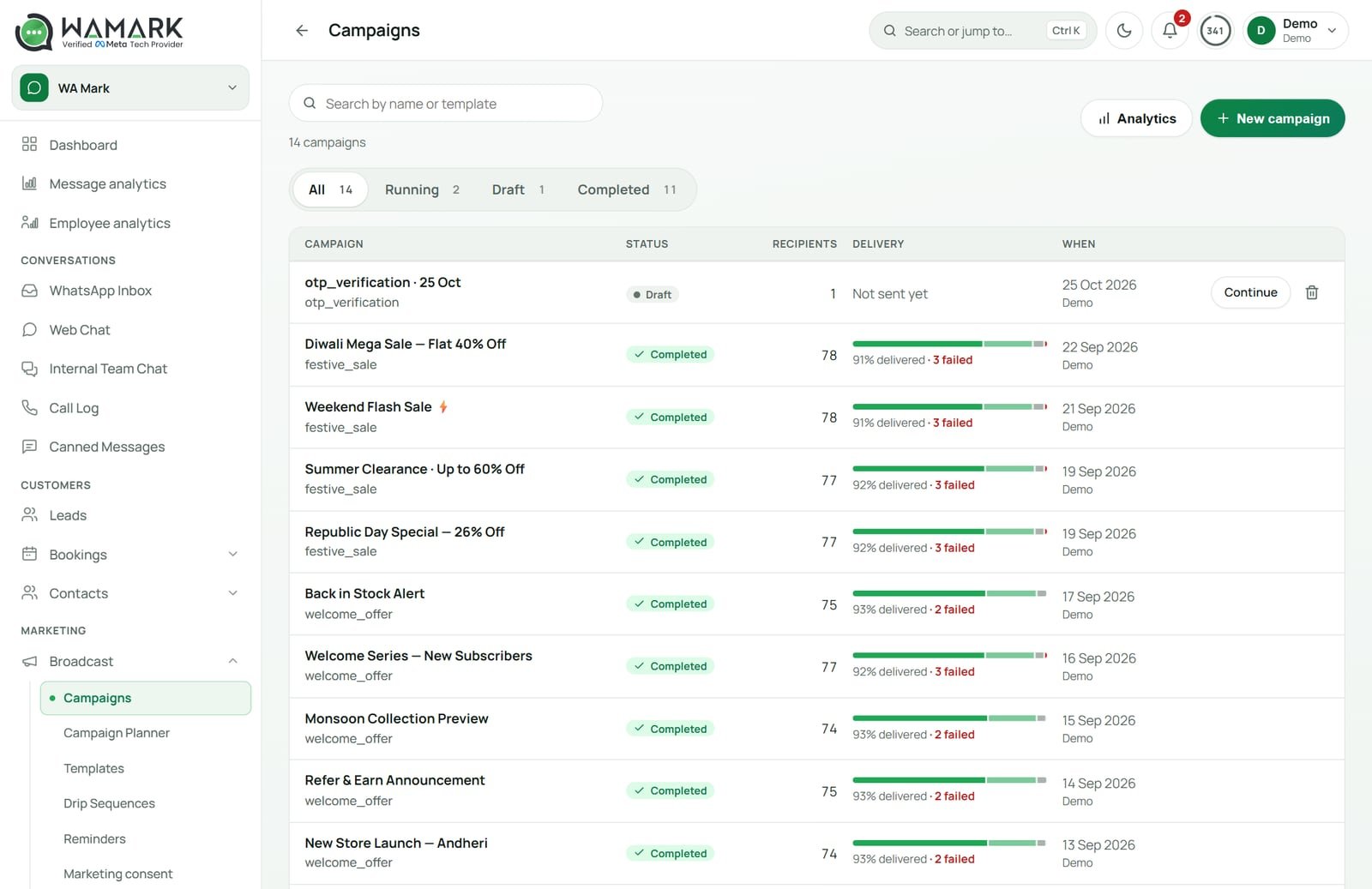
WaMark shows delivery and an estimated cost for every campaign, with plans from ₹999 a month plus 18% GST.
Start with WaMarkSee pricingThe headline rate is where most people stop reading. The real bill also depends on three things the rate card doesn’t show.
First, the category Meta gives each template. You pick a category when you write the template, but Meta can change it. A “your order is ready, grab 10% off your next one” message looks like an update to you. Meta reads it as marketing and bills ₹0.8631, against ₹0.115. That’s 7.5 times the price on a single line.
Second, delivery. Meta bills delivered messages only. A number that’s switched off or blocked you doesn’t cost anything, but a contact who received a message and never opened it costs the full rate. So the whatsapp business api price per useful message is higher than the rate card suggests whenever your list is stale.
Third, the number itself. The free 1,000 service replies belong to each phone number, and they reset every month. Say a business answers 700 chats in a quiet month and 1,900 in a busy one. It pays nothing in the first and 900 × 0.115 = ₹103.50 in the second.
So set a monthly check: open the delivered counts by category and multiply by your rate card. It’s a short job. If the total is off from what Meta billed, the category column is the first place to look.
Take shop A above. ₹536 of Meta fees buys 500 offers in front of people who gave you their number. I’d still send the offer on WhatsApp. I’d also check that every campaign pays back more than it costs.
A quick test: divide the Meta cost of a campaign by the orders it brought. 500 marketing messages cost ₹431.55. If they brought 12 orders, that’s ₹35.96 per order before your software fee. Compare that to what a click costs you on ads.
To bring your WhatsApp business API price down, I’d work through these in order. The first two are free.
One more rule of thumb. If you run more than one number, the 1,000 free service messages apply per number, so spreading support across numbers can change the maths. I wouldn’t restructure a business around a ₹115 saving, but it’s worth knowing.
The WhatsApp business API price from Meta is one line. Your software provider charges separately. The question to ask is whether they add a markup to Meta’s per-message rate. WaMark doesn’t. Meta bills the business directly, and WaMark’s plans start at ₹999 a month before 18% GST (Basic: 1 number, 1,000 contacts, 1,000 campaign messages). There’s no free plan and no free trial.
Want the wider picture of what the software side costs? Read the WhatsApp marketing cost in India breakdown, or check the live plan page.
Before 18% GST, Meta’s India list rates are about ₹0.8631 for a marketing message and ₹0.115 for utility and authentication messages, per delivered message. Some providers quote slightly different figures, up to about ₹0.145 for utility, so confirm the amount on your own WhatsApp Manager rate card.
Meta started charging for free-form service replies beyond a free tier of 1,000 per phone number each month, and for utility templates sent inside an open 24-hour window. Both were free before. Marketing and authentication list prices did not change on that date.
Yes, per Meta’s pricing page: each business phone number gets 1,000 free delivered service messages a month, and unused ones don’t roll over. Utility templates sent in the window get no free allowance that I could find. Check the page for exceptions such as non-profit policies.
Yes. Indian businesses pay 18% GST on top of Meta’s per-message rates and on software fees. A ₹500 Meta subtotal becomes ₹590 with GST. You can usually claim input credit if you’re GST registered, but check with your accountant.
Messages your customers send to you are free. So are messages inside a Click-to-WhatsApp ad’s free entry window, which Meta says may stay open up to 7 days. The first 1,000 service replies per number each month are free as well.
Ready to try it on your own chats?
Plans start at ₹999 a month before 18% GST.
Start with WaMarkSee pricingRelated guides